

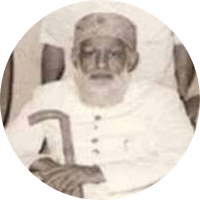
Maulana Hifzurrahman Sivharwi
Authors
Explore 3 published works by this Author — curated for true readers
About Author “Maulana Hifzurrahman Sivharwi”
Identity: A distinguished Islamic scholar, prominent politician, leading figure of the Indian freedom movement, former General Secretary of Jamiat Ulema-e-Hind, and Member of Parliament (India)Maulana Hifzur Rahman Seoharwi was born in 1318 AH/1901 CE in Seohara, district Bijnor, into a respected landowning family. His father, Shamsuddin, served as an Assistant Engineer in the princely states of Bhopal and later Bikaner. He received his early education at Madrasa Faiz-e-Aam, Seohara, and Madrasa Shahi, Moradabad. In 1341 AH, he enrolled at Darul Uloom Deoband and graduated from the Dars-e-Hadith in 1342 AH.After graduation, he was appointed by Darul Uloom Deoband to teach at a madrasa, where he served for a year. During this period, he also began writing and performed the Hajj pilgrimage. Upon returning, he resumed teaching at Deoband and later joined Jamia Islamia Dabhel under the guidance of Allama Anwar Shah Kashmiri, where he taught for five years.In 1937 (1352 AH), at the establishment of Nadwatul Musannifeen in Delhi, he moved there with his associate Mufti Atiqur Rahman Usmani and rendered valuable academic and research services. During this time, he authored important works such as The Economic System of Islam, Ethics and Moral Philosophy, and Stories of the Qur’an. Earlier, during imprisonment, he had written Balagh Mubeen on the life of the Prophet.A significant aspect of his personality was his political insight and activism. He was a leading figure of Jamiat Ulema-e-Hind. At the Amroha session of 1930, he presented a resolution supporting participation in the Indian freedom movement, which initially faced opposition but was eventually passed, establishing his prominence in political circles at a young age.During the 1932 movement, he was appointed head of the volunteer organization under Jamiat’s “Idara Harbiya,” where he traveled across the country organizing the movement and inspiring activists, facing multiple arrests and trials.In 1942, he played a key role in organizing the emergency meeting of the Jamiat’s working committee in Delhi. In 1946, he was part of the delegation that met the Cabinet Mission, where his articulate and reasoned arguments were widely appreciated. He firmly opposed the partition of India and represented the Jamiat’s stance with conviction.After partition, during communal riots, Mahatma Gandhi undertook a fast and expressed trust in the leaders of Jamiat. Maulana Seoharwi assured him of improving conditions, upon which Gandhi broke his fast.Due to continuous engagements, he developed cancer and went to the United States for treatment, but did not recover.Death: He passed away on 2 August 1962 in New Delhi and was laid to rest at the Shah Waliullah cemetery in Mehndiyan.